What Funders Actually Want from Museums (and the Data Most Institutions Still Don’t Have)
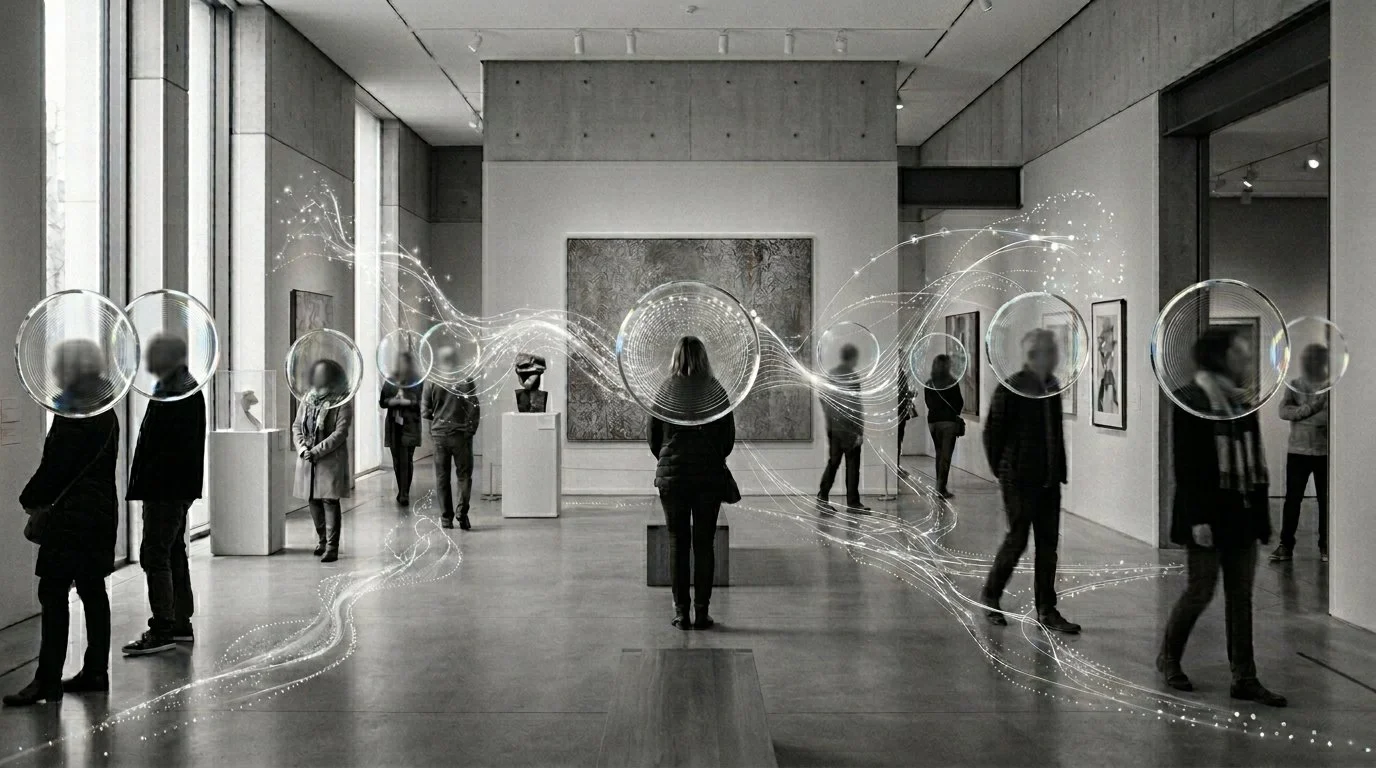
Anonymous, aggregated visitor data can now reveal patterns of curiosity never captured before along museum halls.
Museums are increasingly expected to demonstrate impact, yet most still rely on attendance, surveys, and fragmented analytics that fail to capture real visitor engagement. Traditional methods measure where visitors go, but not what they understand or care about. This article explores how AI-powered museum analytics can complement existing systems by analyzing anonymized, aggregated visitor interactions to reveal patterns of curiosity, learning, and engagement. By moving beyond attendance metrics toward understanding visitor intent, museums can strengthen funding applications, improve interpretation, and better demonstrate their value to funders, stakeholders, and communities.
I spent more than twenty years working in museums, and part of that time was dedicated to understanding visitors in a very direct, very physical way. This was not abstract research. We followed people through exhibitions, observed where they stopped, what they pointed at, whether they talked to each other, and how long they stayed in a particular area. At the end of their visit, we interviewed them and tried to reconstruct what they understood, what they remembered, and what stayed with them.
When I was working at the Liberty Science Center, I even had the chance to meet Beverly Serrell, whose work has shaped how museums think about visitor behavior. Her research made something very clear. Visitors do not consume exhibitions the way we imagine they do. They move quickly, they select, they skim, and they engage with only a fraction of what is presented to them. Once you see that pattern in real life, it becomes impossible to ignore.
We conducted many of these studies over the years, including at the American Museum of Natural History. One of the last evaluations I worked on cost close to $100,000 and involved a full team of researchers, structured observation protocols, interviews, and detailed reporting. The work was rigorous and, in many ways, incredibly insightful. It gave us a clearer understanding of how visitors moved through exhibitions and where engagement seemed to happen.
At the same time, it always felt incomplete.
What We Know, and What We Don’t
Those studies taught us a great deal about behavior, but they also revealed the limits of what we could capture. We could see where people stoped, but we could not fully understand what they were thinking in that moment. We could measure how long they stayed, but not whether something actually made sense to them or changed their perspective.
Even the most thorough reports had a built-in constraint. They were snapshots taken after the fact, not continuous insight into the experience as it unfolded. By the time the findings were compiled and delivered, the exhibition was already open, and translating those insights into meaningful changes was often difficult. The data was valuable, but it arrived late and only told part of the story.
What we were missing was not better observation.
We were missing access to curiosity.
The Pressure to Prove Impact
At the same time, expectations around museums have shifted significantly. Funding is no longer tied only to attendance or institutional reputation. Museums today are expected to demonstrate public value, learning outcomes, and relevance to the communities they serve.
Family offices, private donors, grant-making institutions, corporate sponsors, and government agencies are all asking variations of the same question. What difference does this museum actually make? Guidelines from organizations such as the Institute of Museum and Library Services and the National Endowment for the Arts increasingly emphasize outcomes and impact, not just activity.
This creates a tension that many institutions are still navigating. Museums are being asked to demonstrate impact, but the tools available to measure that impact are limited.
The Systems We Have Today
Most museums already collect a significant amount of data, but that data is spread across multiple systems that were never designed to work together. Ticketing systems provide attendance numbers, CRM platforms track donors and members, surveys attempt to capture satisfaction or learning, and in some cases sensors or digital tools estimate movement through galleries.
Each of these systems offers a partial view. Together, they can become complex to manage and difficult to interpret. Maintaining them requires time, staff capacity, and financial investment. It is not unusual for a mid-sized institution to spend around $200,000 annually across tools, systems, and personnel dedicated to measurement and reporting.
Even with that level of investment, the resulting picture remains fragmented. Museums have become very good at measuring presence, but they still struggle to measure understanding.
What It Means to Measure Curiosity
For the first time, we have the possibility of measuring something museums have always cared about but never been able to capture directly.
Curiosity.
Not inferred curiosity. Not guessed curiosity. Actual curiosity, expressed in the form of questions.
When a visitor asks, “Why did David paint the Death of Socrates?” that is curiosity.
When they ask, “Why did Socrates accept his fate instead of running away?” that is curiosity.
When they follow up with, “Why did they want to execute him?” that is curiosity deepening.
This is fundamentally different from tracking movement or dwell time. It is not about where people go. It is about what they are trying to understand.
Curiosity reveals intent. It reveals gaps in knowledge. It reveals what resonates and what does not.
It is, in many ways, the closest measurable signal we have to learning in real time.
A New Layer of Museum Analytics
This is where systems like WonderWay introduce a new layer of insight.
By analyzing anonymized and aggregated conversations between visitors and institutional knowledge, we can begin to see patterns of curiosity at scale. We can understand which objects generate questions, which narratives invite deeper exploration, and where visitors consistently ask for more context.
We can begin to identify where interpretation is working and where it is not, not based on assumptions, but based on the questions people actually ask.
We can observe how engagement shifts across languages, how different audiences approach the same content, and how visitors build their own pathways through ideas rather than through space.
This kind of data has never really existed in museums in a continuous, scalable way.
And importantly, it does not require identifying individuals. The data is anonymous and aggregated from the start. It is not about tracking people. It is about understanding patterns of engagement with knowledge.
Why This Matters for Funding
This changes how museums can talk about impact.
Instead of saying, “We had X visitors,” institutions can begin to say, “Visitors engaged deeply with these themes. These were the questions they asked. This is where curiosity concentrated. This is where understanding expanded.”
Funders are increasingly looking for this kind of evidence. They want to see not just activity, but outcomes and impact. They want to understand how institutions are connecting with audiences in meaningful ways.
Curiosity, when measured responsibly and interpreted carefully, becomes a bridge between what museums present and what visitors take with them.
What This Makes Possible
Museums have always been places of knowledge, shaped by research, interpretation, and care. What is changing is not the mission, but the ability to observe how that mission unfolds in the minds of visitors.
For the first time, insight into visitor engagement does not have to rely only on observation, surveys, or occasional studies. It can begin to reflect how people think, question, and explore.
And that changes everything.
Bibliography
Falk, John H. Identity and the Museum Visitor Experience. Routledge, 2009.
Falk, John H., and Lynn D. Dierking. The Museum Experience Revisited. Routledge, 2013.
Marty, Paul F. “Museum Websites and Museum Visitors: Digital Museum Resources and Their Use.” Museum Management and Curatorship, vol. 23, no. 1, 2008, pp. 81–99.
Parry, Ross. Museums in a Digital Age. Routledge, 2010.
Serrell, Beverly. Exhibit Labels: An Interpretive Approach. AltaMira Press, 1996.
American Alliance of Museums. Core Standards for Museums. American Alliance of Museums, 2015.
Institute of Museum and Library Services. Performance Measurement and Results Framework. IMLS, 2022.
National Endowment for the Arts. Final Descriptive Report Guidelines. NEA, 2021.
UK National Lottery Heritage Fund. Evaluation Guidance. National Lottery Heritage Fund, 2022.
European Commission. Europeana Strategy 2020–2025: Empowering the Cultural Heritage Sector in the Digital Transformation. European Commission, 2020.
European Union. General Data Protection Regulation (EU) 2016/679. Official Journal of the European Union, 2016.
California Consumer Privacy Act of 2018, Cal. Civ. Code § 1798.100 et seq.
Pew Research Center. Americans and Privacy: Concerned, Confused and Feeling Lack of Control Over Their Personal Information. Pew Research Center, 2019.
UNESCO. Recommendation on the Ethics of Artificial Intelligence. UNESCO, 2021.
OECD. Measuring the Digital Transformation: A Roadmap for the Future. OECD Publishing, 2019.
Author: Hélène Alonso
Hélène Alonso is founder of WonderWay and a professor at New York University. She is a museum technology leader with over two decades of experience at institutions including the American Museum of Natural History, Liberty Science Center, and the Wildlife Conservation Society. Her work focuses on artificial intelligence infrastructure for museums, institutional knowledge systems, and the future of cultural interpretation.
Summary
Museums are under increasing pressure to demonstrate impact, yet most still rely on attendance and surveys that fail to capture real engagement. This article explores how AI-powered analytics can complement existing systems by measuring visitor curiosity through anonymized, aggregated interactions, helping institutions better understand audiences, improve interpretation, and strengthen funding outcomes.
Keywords
museum analytics, AI in museums, visitor engagement, museum data analytics, cultural analytics, museum KPIs, audience engagement, museum evaluation, visitor behavior, museum funding, impact measurement, anonymized data
Key Concepts
Visitor engagement vs attendance
Measuring curiosity as a proxy for learning
Fragmented museum data systems
AI as a complement to existing analytics
Privacy through anonymized and aggregated data
Connecting engagement to funding and impact
Key Takeaways
Museums measure presence more effectively than understanding
Visitor research shows selective engagement with exhibitions
AI enables insight into curiosity through visitor questions
Aggregated data allows ethical and privacy-safe analytics
Stronger data improves funding narratives and institutional strategy
FAQ
What is museum analytics? Museum analytics refers to the collection and analysis of data to understand visitor behavior, engagement, and learning outcomes.
How can AI improve museum analytics? AI can analyze anonymized visitor interactions to reveal patterns of curiosity, engagement, and knowledge gaps.
Does this compromise visitor privacy? No, when designed correctly, systems use aggregated and anonymous data without identifying individuals.
Why does this matter for funding? Funders increasingly require evidence of impact, learning outcomes, and audience engagement beyond attendance.