What Visitors Actually Wonder: Inside the Conversation Layer
Thought anonymous user data from we can now unveil the patterns of curiosity emerging from WonderWay’s Conversational Layer.
For the first time, we can hear what visitors actually wonder about when they stand in front of a work of art. This article is a first look inside the Conversation Layer data: the questions WonderWay users asked this winter, across museums in New York, Madrid, Florence, and Singapore, in eight languages, across every kind of visitor. What they asked turns out to be one of the most revealing datasets museums have never had.
Three questions asked by WonderWay users this winter. No context. No prompting.
"He could have run away instead."
"Do farts have colors?"
"Parlami di Calatrava."
One of these questions was asked by a woman standing in front of Jacques-Louis David's The Death of Socrates at the Metropolitan Museum in New York, trying to make sense of why a philosopher would choose to drink hemlock when escape was plainly available. Another came from a child at the American Museum of Natural History who had been working through something that had clearly been on his mind for some time. The third came from a visitor at the Uffizi Gallery in Florence, who had started the conversation in English, switched to French, then landed in Italian before asking about an architect whose buildings have nothing to do with the Renaissance paintings on the walls around him.
None of these visitors were completing a survey. None had been prompted by a guide or a label. They were simply standing in front of something that made them want to know more, and they asked. All three questions came through WonderWay, the voice-first companion that launched globally last December. And what makes them interesting is not that they are unusual. It is that they are representative.
What We Can Now Hear
In March 2026, this blog introduced the concept of the Conversation Layer: a new interpretive medium where visitors ask questions in real time, by voice, grounded in museum-approved knowledge, while remaining fully present with the collection. The argument was about what the medium could become. This article is about what it has already produced.
Since launching last December, WonderWay has captured more than three thousand five hundred visitor questions and exchanges across museums in New York, Madrid, Florence, Singapore, and beyond. Every session is anonymized and aggregated. No visitor is identified. What the data reveals is not who was there, but what they needed to understand. And that, it turns out, is something museums have never had access to at scale before.
The conversations also reveal how deeply visitors engage when the medium meets them where they are. Among WonderWay users who move beyond an initial question, sessions average over eight minutes. The longest on record ran close to thirty minutes, with a single visitor spending nearly that entire time on two paintings. To put that in perspective: the average museum visitor spends less than thirty seconds in front of any given artwork. The presence of a real conversation changes that equation entirely.
Six Kinds of Questions
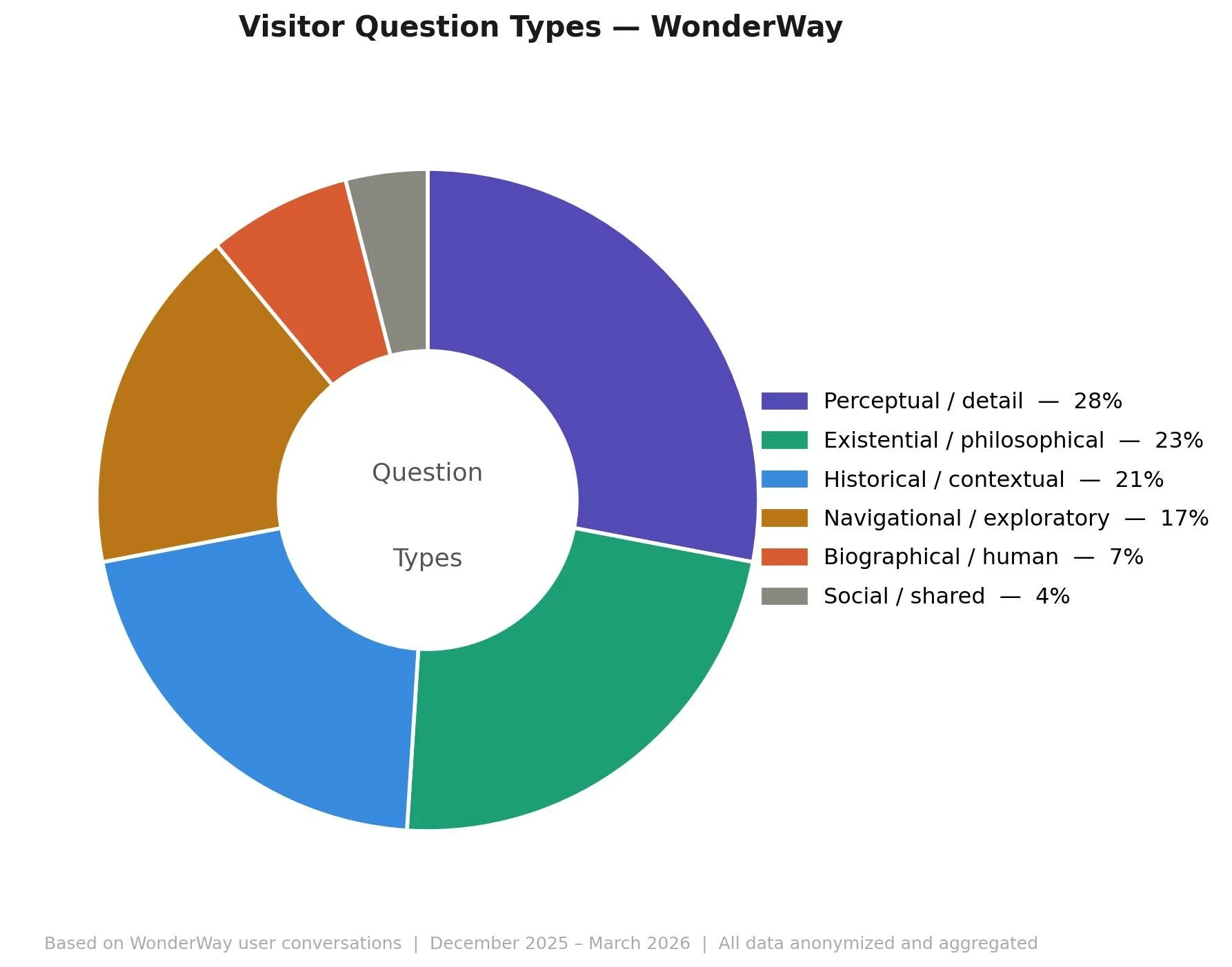
One of the first things that becomes clear when reading through a large volume of visitor questions is how varied they are, not just in subject matter, but in what they reveal about the person asking. A question is never only a request for information. It carries what the visitor already knows, what they are feeling, and what they have brought with them into the room. After analyzing the full dataset of WonderWay conversations from this winter, six recurring patterns of curiosity emerged.
The largest group, and the one that surprises people most when they encounter it, is what we call perceptual curiosity: the question that begins with something noticed. "Why is there so much gold on his armor?" "The crucifix is sitting on a mound of dirt. Why?" "I notice the dress is very low-cut for a time when women were expected to be proper." These questions come from visitors who are looking closely and want the painting to explain itself to them. They are the questions that labels almost never answer, because they depend entirely on what that particular visitor noticed, in that particular moment, standing in that particular spot.
Close behind them are existential and philosophical questions, which often arrive together with a third type, biographical curiosity. Existential questions reach past the artwork into the human situation it depicts: "He could have run away. Why didn't he?" "Do you think he believed in life after death?" Biographical ones go after the person: "Was he married?" "Did his children follow his path?" These two categories tend to cluster, and they tend to mark the visits where something real has happened, where a visitor has stopped being a tourist and started being a thinker.
Historical and contextual questions sit in related territory: visitors reaching for the world around the artwork, not just the artwork itself. "What else was happening in 1787 when this was painted?" "Was this always in a frame, or was it once part of an altarpiece?" These are the questions most professional guides are trained to answer, and yet they emerge here without anyone suggesting they should be asked.
Then there are navigational and exploratory questions, which tell a different kind of story. "I've been here for forty-five minutes and I haven't seen a single painting by a woman. Where would I find one?" That question, which arrived from a visitor moving through the Met's European galleries, is not really about directions. It is about the shape of a canon and who gets left out of it. Navigational questions frequently carry more intellectual weight than they appear to.
Finally, there are social questions, the least frequent in the dataset but among the most affecting. These are the questions asked in the presence of someone else, or on behalf of someone else. A parent translating their child's wonder into words. A friend pulling a companion into a story. A child who needs one more beat of courage before asking what they actually want to know. And across roughly fifteen percent of all WonderWay sessions this winter, questions arrived in languages other than English: Spanish most frequently, accounting for forty-two percent of non-English conversations, followed by Chinese at thirty percent, then Portuguese, Italian, Arabic, Hindi, and French. These are not a footnote. They are a reminder that curiosity does not have a mother tongue.
Based on WonderWay user conversations | December 2025 to March 2026 | All data anonymized and aggregated
Three Visits
Categories are useful, but they flatten the texture of what actually happens when a person is genuinely curious in front of a work of art. Here are three visits from this winter's WonderWay data, each one a different museum, a different visitor, a different kind of wonder.
The woman who kept asking about Socrates
On a December afternoon at the Metropolitan Museum of Art, a visitor stopped in front of Jacques-Louis David's The Death of Socrates and stayed for nineteen minutes. The conversation began simply, with a request to understand what was happening in the painting. Then came the first turn that no audio guide would have anticipated.
"He could have run away instead. Didn't the people who loved him revolt against the authorities?"
She was not asking about compositional choices or the symbolism of the hemlock cup. She was morally troubled by the scene. Over the next several minutes, her questions came in quick succession, each one drilling deeper into the human situation rather than the artistic one. Was Socrates married? Did they have children? Did the children follow in his philosophical footsteps? With each answer came another question, each one opening a new gap. Then, at the thirteen-minute mark, something shifted. She said: "Let's talk about the painting Madame X by Sargent." Not the painting next to it. A different canvas entirely, perhaps glimpsed across the room, or carried in memory from an earlier pass through the galleries.
The Madame X questions had the same quality. "Was the woman in the painting ostracized after being painted like this?" "Did her husband leave her?" The artwork was, for this visitor, a portal into the lives of real people. Not symbolism. Not technique. People making choices under pressure, and bearing consequences. In nineteen minutes and twenty-three exchanges, she moved from the trial of Socrates in 399 BC to the salons of 1884 Paris, from philosophy to social scandal, without once losing the thread. That is not a museum visit that a standard visitor study would have captured. It is almost certainly not a visit she herself could have reconstructed in an exit survey.
A child and the question of farts
On a December visit to the American Museum of Natural History in New York, a parent arrived with a nine-year-old who was, by the parent's own description, always full of funny questions. The child was shy at first. He did not say much. Then his parent passed along what he wanted to ask.
"He wants to know if farts have colors."
Gases are invisible, came the response, so farts do not have colors, though they absolutely have molecules, and those molecules are what the nose detects. The child was not done. "And do farts have particles of the things they smell?" Yes, in a way. The smell comes from specific chemical compounds produced by bacteria, not from particles of the substance itself, though the distinction is subtle enough that he pushed back: "So if you smell poo, it's because particles of poo are coming inside your nose." That exchange lasted ninety seconds and covered molecular chemistry, bacterial decomposition, and olfactory biology at a level that would not embarrass a middle-school science class.
What this moment illustrates is not that WonderWay handled an unexpected question gracefully, though it did. It is that the system shifted register instinctively and without being told to, from the philosophical depth of a nineteen-minute adult conversation to the warm, scientifically precise level of a nine-year-old working through something genuinely curious to him. That capacity, to move from expert to novice, from solemnity to play, without condescension and without breaking the logic of the exchange, is one of the things that distinguishes the Conversation Layer from anything that came before it.
Three languages at the Uffizi
In February 2026, a visitor at the Uffizi Gallery in Florence opened a WonderWay session in English. Within a minute, they had switched to French. Within two, they were in Italian, asking first about the iconography of calaveras, then pivoting to Santiago Calatrava, the architect, whose relationship to the Renaissance paintings surrounding the visitor was entirely personal and entirely unclear.
The session is brief. It is also a precise illustration of what the Conversation Layer makes visible globally. The visitor was not confused. They were testing the range of what they had in front of them, the way you might try a new instrument by playing something you already know, in the key you feel most at home in. They wanted to know whether the voice in their ear would follow them across languages and subjects. It did.
Fifteen percent of all WonderWay sessions this winter included messages in a language other than English. In several instances, visitors switched languages mid-conversation, sometimes asking a question in one language and receiving an answer before continuing in another. The system adapted each time. For a museum thinking about how to serve international audiences, that number is not a statistic. It is an invitation.
What the Questions Tell Us
The psychologist Daniel Berlyne mapped curiosity as a distinct motivational state in the 1950s, drawing a line between perceptual curiosity, the pull toward novelty and sensation, and epistemic curiosity, the drive to close a specific gap in knowledge. Decades later, George Loewenstein refined this with his information-gap theory: curiosity is not simply the desire to know more. It is the awareness of a precise thing you do not yet know. The gap creates tension. The tension produces the question.
Both frameworks illuminate what appears in the WonderWay data. Perceptual curiosity arrives first: a visitor notices something and reaches for an explanation. Epistemic curiosity comes in the follow-up, when the first answer opens a gap rather than closing one. "He could have run away instead" is Loewenstein's information gap made audible. Knowing that escape was possible means she now needs to understand why it was refused. One answer produces three more questions. That chain is, in every meaningful sense, learning happening in real time.
What the Conversation Layer makes it possible to measure is not whether learning occurred, which is always difficult to verify, but where the conditions for it were present. Question depth, how many follow-ups a visitor asks before moving on, is a reasonable proxy for how much a particular object or narrative invited real engagement. Question breadth, how far a single conversation travels from its starting point, shows the associative range of the visit. And the moments when a visitor's own life enters the exchange, the parent who notes that she has two boys and is going nuts, the woman who spots herself in Xanthippe's exhaustion, mark the points of deepest connection, where a painting stops being a historical object and becomes a mirror.
What Institutions Can Do with This
The most immediate application of this data is interpretive. When WonderWay users consistently ask the same question in front of a particular work, that is a label failing to answer something, or an audio guide skipping something, or an education program missing something entirely. When a work that appears minor in the collection generates an unusually long chain of follow-up questions, that is a signal about presentation that no attendance report would ever surface. When visitors from a dozen different countries ask about a single object across a single month, in six different languages, that is a signal about global resonance that changes how an institution might think about that object's place in its programming.
For funders and institutional stakeholders, the shift is equally significant. Museums have long been asked to demonstrate impact without adequate tools to measure it. Attendance tells you how many people entered. Dwell time tells you where they slowed down. Neither tells you what they understood, what they felt, or what they left wanting to know more about. Visitor curiosity, captured responsibly through anonymized, aggregated questions, offers the closest approximation we have to real engagement measured in real time. It is not a replacement for traditional evaluation. It is the layer that has always been missing.
The WonderWay conversations this winter came from visitors of every profile. Knowledgeable visitors who asked about Palladian architecture and camera obscura technique. Families navigating the difference between a molecule and a particle. Teenagers who tested the system with off-topic questions before giving it their real ones. A solo traveler at the Uffizi on a February afternoon working through three languages in four minutes. A parent at the Reina Sofía in Madrid asking about Guernica in Spanish. A grandmother in Singapore who simply wanted to know what she should not miss. The Conversation Layer does not ask who they are before it responds. It listens to the question and follows from there.
The Founding Circle
Something is already underway. WonderWay is working with cultural institutions to define what the Conversation Layer becomes next, and what it owes the collections and visitors it serves. We call this the Founding Circle. A very limited number of additional spots will become available. More on this soon.
Selected References
Berlyne, D. E. Conflict, Arousal, and Curiosity. McGraw-Hill, 1960.
Loewenstein, George. "The Psychology of Curiosity: A Review and Reinterpretation." Psychological Bulletin, vol. 116, no. 1, 1994, pp. 75-98.
Falk, John H., and Lynn D. Dierking. The Museum Experience Revisited. Routledge, 2013.
Serrell, Beverly. Exhibit Labels: An Interpretive Approach. AltaMira Press, 1996.
Alonso, Hélène. "The Conversational Layer: A New Interpretive Medium for Museums." WonderWay.ai, March 9, 2026.
Alonso, Hélène. "What Funders Actually Want from Museums." WonderWay.ai, March 23, 2026.
American Alliance of Museums. Facing Change: The Demographics of the Museum Workforce. AAM, 2018.
Hélène Alonso is the founder of WonderWay and a professor at New York University. She is a museum technology leader with over two decades of experience at the American Museum of Natural History, Liberty Science Center, and the Wildlife Conservation Society. Her work focuses on AI infrastructure for museums, institutional knowledge systems, and the future of cultural interpretation.
TL;DR
WonderWay users asked more than 3,500 questions inside museums this winter, in eight languages, across institutions on four continents. This article introduces a taxonomy of six visitor curiosity types captured through the Conversation Layer, with case studies from the Metropolitan Museum, the American Museum of Natural History, and the Uffizi Gallery in Florence. Engaged visitors averaged over eight minutes per session. The data represents a new category of museum analytics: curiosity measured in real time, at scale, through questions visitors actually asked.
Key Takeaways
The Conversation Layer, a term coined by WonderWay, captures visitor curiosity through real-time voice questions grounded in museum-approved knowledge.
Six types of visitor questions emerge consistently across museums: perceptual, existential, historical, navigational, biographical, and social.
Fifteen percent of WonderWay sessions this winter were conducted in a language other than English, across eight languages including Spanish, Chinese, Portuguese, Italian, Arabic, Hindi, and French.
Among engaged visitors, sessions averaged over eight minutes, with the longest running close to thirty minutes.
Visitor questions are a measurable proxy for learning in real time, something no prior museum evaluation tool has captured continuously and at scale.
The Founding Circle is now active. A very limited number of additional spots will become available for cultural institutions.
FAQ
What is the Conversation Layer? The Conversation Layer is a term coined by WonderWay to describe a voice-first interpretive medium in which museum visitors ask questions in real time and receive responses grounded in museum-approved knowledge, while remaining present with the collection. It was first defined in a March 2026 article on this blog.
What kinds of questions do museum visitors ask through WonderWay? WonderWay data from this winter identifies six recurring types of visitor questions: perceptual questions about what they notice in a work, existential and philosophical questions about the human situations depicted, historical and contextual questions about the world around the artwork, navigational and exploratory questions about how to move through a collection, biographical questions about the people involved, and social questions asked on behalf of or in the presence of another person.
How long do WonderWay sessions last? Among visitors who move beyond an initial question, sessions average over eight minutes. The longest session on record ran close to thirty minutes.
Does WonderWay work in languages other than English? Yes. Fifteen percent of all WonderWay sessions this winter were conducted in a language other than English. Spanish accounted for forty-two percent of non-English sessions, followed by Chinese at thirty percent, then Portuguese, Italian, Arabic, Hindi, and French. Some visitors switched languages mid-conversation.
How is visitor data handled? All WonderWay conversations are anonymized and aggregated from the outset. No visitor is identified. The data is used to understand patterns of curiosity across collections, not to track individuals.
What is the WonderWay Founding Circle? The Founding Circle is a working partnership between WonderWay and cultural institutions engaged in shaping the future of the Conversation Layer. A limited number of additional spots will become available. Details will be announced in the coming weeks.
How is the Conversation Layer different from an audio guide or a chatbot? Audio guides deliver a fixed, linear script. Chatbots are typically trained on open internet data without institutional oversight. The Conversation Layer adapts to each visitor's questions in real time and retrieves from curated, museum-approved sources rather than improvising.
Can the Conversation Layer data help museums with funding? Yes. Visitor questions provide a measurable signal of engagement and curiosity that traditional metrics such as attendance or dwell time cannot capture. This gives institutions a new way to demonstrate impact to funders and stakeholders.
Keywords
museum visitor engagement, AI in museums, conversational AI for museums, museum analytics, visitor curiosity, the Conversation Layer, WonderWay, museum interpretation, voice AI museum guide, multilingual museum experience, museum learning outcomes, cultural institution technology, museum visitor questions, AI museum companion, visitor experience innovation, museum impact measurement, curiosity measurement, museum education technology, AI cultural heritage, museum digital transformation
Key Concepts
The Conversation Layer A voice-first interpretive medium where visitors ask real-time questions grounded in museum-approved knowledge, coined by WonderWay.
Perceptual curiosity Questions triggered by something a visitor notices in a work of art or exhibit.
Epistemic curiosity The drive to close a specific knowledge gap, expressed through follow-up questions.
Information-gap theory George Loewenstein's framework explaining that curiosity arises from awareness of a precise thing one does not yet know.
Visitor question depth The number of follow-up questions a visitor asks before moving on, used as a proxy for genuine engagement.
The Founding Circle WonderWay's working partnership with cultural institutions defining the future of the Conversation Layer.