What Is WonderWay? The Platform Turning Museums Into Conversations
WonderWay is an AI platform built specifically for museums and cultural institutions. Grounded in verified curatorial knowledge rather than general internet data, it transforms physical spaces into responsive environments where visitors can follow their curiosity conversationally. This piece explains how it works, why the barrier to entry is lower than most institutions assume, and why a quiet group of forward-thinking museums has already begun.
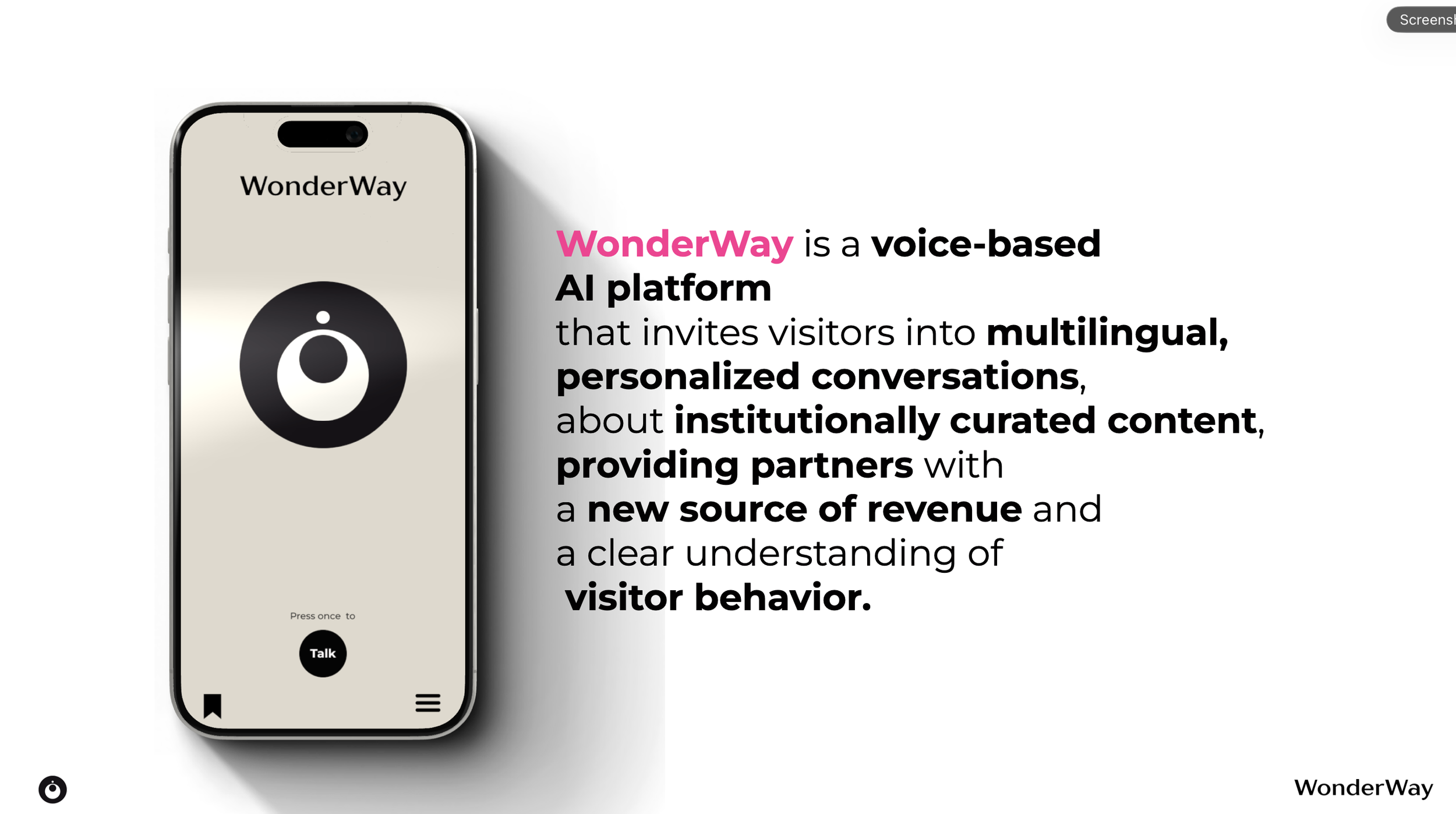
WonderWay is a voice-based AI platform for cultural spaces. It transforms institutionally curated knowledge into personalized, multilingual conversations with visitors, generating insight and revenue for the institutions that host them.
There is a question that follows almost every piece we publish. We write about AI and authorship, about what happens to institutional trust when machines begin to speak in spaces built on human knowledge, about the particular responsibilities that come with deploying technology inside culture. The response is consistent: people find the ideas useful, the debates worth having. And then, somewhere in the exchange, the same thing surfaces.
But what exactly is WonderWay?
It's the right question to ask, and we haven't answered it plainly enough. So here it is.
A Platform, Not an App
WonderWay is not an audio guide with a conversational interface bolted on. It is not a chatbot dressed up for gallery walls. Understanding what it actually is requires setting aside the category of "museum app" almost entirely, because that category was built around a different set of assumptions: that digital tools in cultural spaces should be self-contained, visitor-facing, and essentially decorative.
WonderWay is a platform. It integrates with an institution's existing knowledge infrastructure, ingests and structures curatorial content, manages multilingual delivery, captures anonymized behavioral data, and serves all of it through a voice interface that works across museums, heritage sites, historic buildings, and open architectural spaces. It is, in the most literal sense, an operating layer for how institutions communicate with the people inside them. The complexity lives in the back end. The experience, for the visitor, feels like a conversation.
The Bridge We Have Been Missing
Every significant collection in the world sits on top of a problem it did not create. The objects are extraordinary. The scholarship is deep. The histories compressed into a single room can span centuries and cross continents. And yet the person standing in front of it, arriving with genuine curiosity and almost no context, has almost no way in.
This gap between what an institution knows and what a visitor can access is not new, and it is not for lack of effort. Labels, audio guides, docent programs, digital interactives: every generation of tool has taken a run at it. None of them have solved it, because none of them were built around the actual shape of curiosity. Curiosity is not linear. It doesn't follow a predetermined sequence or stay within the boundaries of a single object. It drifts, connects, doubles back, and suddenly wants to know something the label never anticipated.
WonderWay is built for that. It is a bridge between the question a visitor doesn't quite know how to ask and the knowledge an institution has spent decades assembling. It works in museums, in heritage sites, in historic city centers, in any space where the physical environment carries more meaning than most of the people moving through it will ever reach on their own.
The Problem With Trusting AI
When institutions hear the word AI, the concern that follows most quickly is hallucination. It is the right concern. General AI models are trained on the open internet, which means they are trained on everything: the accurate and the approximate, the scholarly and the invented, the rigorously sourced and the confidently wrong. In a consumer context, a plausible-sounding error is a minor inconvenience. In a museum, it is a different kind of problem entirely. It touches provenance, historical record, cultural representation, and the trust that institutions spend generations building with the communities whose histories they hold.
WonderWay approaches this differently, and the difference is structural. At the center of the platform is the Curatorial Intelligence Engine, a proprietary system that grounds every response first in content the institution has authored, approved, and owns. Within that boundary, the risk of misattribution or invented provenance is reduced dramatically. No AI system can claim to be entirely immune to hallucination, but the Curatorial Intelligence Engine is designed to make institutional knowledge the first and primary authority, with the open web available as an extension only when the institution chooses to enable it and curiosity wants to travel further than the collection alone can take it.
That last point matters. Curiosity rarely stops at the wall label. A visitor asking about an object's cultural origins may want, by the end of the conversation, to understand the broader historical movement it belonged to, the literature it influenced, the way contemporary artists are responding to it today. The Curatorial Intelligence Engine can follow that thread, moving from verified institutional knowledge outward into the wider world of ideas, on the institution's terms.
We've written about why this distinction matters in pieces on hallucination and the limits of general models, authorship and institutional voice, and why curation is a foundation, not a feature. The short version: trust, in cultural spaces, is not a soft value. It is the product.
A Conversation That Knows Who It's Talking To
Not every visitor arrives the same way. A ten-year-old and a doctoral candidate standing in front of the same object are having entirely different experiences, and neither of them is well served by the same label, the same audio script, or the same predetermined narrative.
WonderWay adapts. The platform speaks in more than twenty languages, but language is only the beginning of personalization. The Curatorial Intelligence Engine reads the register of each conversation and adjusts: the vocabulary it uses, the depth it goes to, the references it reaches for, the pace at which it moves through complexity. A visitor who signals specialist knowledge gets a different conversation than one who is encountering a subject for the first time, and both leave having gone as far as their curiosity was willing to travel. The platform doesn't manage visitors through an experience. It meets them inside one.
Eyes Up
There is a physical dimension to this that tends to get lost in conversations about museum technology. Most digital tools in cultural spaces ask visitors to look down. At a screen, at a device, at an interface that competes, however elegantly, with the thing it's meant to illuminate. The object recedes. The mediation advances. The visit becomes, in some essential way, about the tool.
Voice does something different. It keeps people in the room. Eyes on the work. Attention on the space. Awareness intact and oriented toward what's actually there.
WonderWay uses voice deliberately, not as a convenience but as a philosophy. We think of it as the Conversation Layer: not an overlay that sits on top of experience and flattens it, but a layer that activates it. A visitor standing in front of a work isn't being managed through a sequence of information. They're being met in the moment of actual attention, when curiosity is live, and offered something that deepens rather than redirects it. The phone stays in the pocket. The imagination does the work it came here to do.
AI for Good Is Not a Slogan
We are deliberate about this. The conversation around AI is moving fast, and the pressure to adopt, to demonstrate innovation, to stay visible in a rapidly shifting landscape, is real for cultural institutions. But speed without principles produces the kind of AI deployment that erodes exactly what institutions are trying to protect.
WonderWay was built on a specific conviction: that AI should help knowledge join the twenty-first century without abandoning the values that made it worth preserving. That means protecting the diverse voices embedded in collections, not homogenizing them through a generic model. It means representing histories with the specificity they deserve, not the approximation a general system can manage. It means being honest about what the technology can and cannot do, and building the constraints into the architecture rather than relying on guidelines that can be ignored.
This is the company's mission, not as a positioning statement but as an engineering choice.
What the Data Makes Possible
Beyond the visitor experience, WonderWay gives institutions something they have never had in a useful form: a genuine understanding of how people engage with their collections. Every conversation generates anonymized, aggregated data about what visitors are curious about, where attention concentrates, which narratives resonate and which fall flat, which parts of the collection are invisible to most people and which consistently stop them in their tracks.
This is not surveillance. No personal data is collected or stored. What institutions receive is behavioral insight at the collection level: information that can inform acquisitions, shape programming, guide label writing, support funding applications, and help institutions make the case, with evidence, for the decisions they've already been making on instinct. It is, among other things, a policy tool. And it is one that no exit survey, however well designed, could produce.
The Longer Vision
What WonderWay is building toward is something larger than a better museum experience. The platform is designed around a vision of connected knowledge: a world where what you've read, watched, and learned doesn't stay siloed in the platforms where you encountered it, but travels with you into the spaces you inhabit.
Imagine standing in front of an object that connects to a documentary you watched last year, a novel you read a decade ago, a conversation you had in another city in front of a related work. The knowledge you already carry becomes part of the experience. Books, television, film, academic writing, the accumulated cultural literacy a person builds over a lifetime: WonderWay is building the infrastructure to make all of it relevant in the moment you're standing somewhere extraordinary, with your attention fully present and nowhere else to be.
Why WonderWay Is Different
There are other companies applying AI to cultural spaces. The distinction worth understanding is not about any single feature. It is about what the system is, from the ground up.
General AI tools can be deployed in museums. They will often sound informed. But they were not designed for this. They cannot ground responses in institutional authority, cannot adapt fluidly to the knowledge level of each visitor, cannot deliver a genuinely personalized experience across twenty languages, and cannot give institutions the curatorial ownership over the conversation that cultural stewardship demands.
WonderWay was designed for this. The combination of voice without screens, the Curatorial Intelligence Engine, deep personalization, multilingual delivery, and interaction design built specifically for the rhythms of cultural exploration: self-directed, unhurried, driven by genuine curiosity rather than predetermined paths. Each of these is a deliberate choice. Together, they are what makes the platform genuinely difficult to replicate, because replicating any one of them without the others produces something that is merely adequate in a space where adequate is not enough.
From Pilot to Platform
For institutions considering what it would actually take to get started, the answer is simpler than most expect. The questions that matter are these: Do you have Wi-Fi? Is any portion of your collection digitized? Do you have a spreadsheet covering even part of your holdings? Do you hold the rights to your materials? If most of these are yes, you are already in position.
A pilot can be scoped to a single gallery, a single collection thread, a single narrative. It can be ready in weeks. From there, rollout follows the shape of real use: what visitors actually engage with, what the data reveals, where the institution wants to go next. There is no obligation to overhaul everything at once. There is only the decision to begin.
The Founding Circle
A small number of institutions did not wait. Before the field had reached consensus, before the conversation had become loud enough to make the decision feel safe, they were already asking the right questions and moving when the answers became available. They are the WonderWay Founding Circle.
This is not a product tier or a marketing category. It is an invitation-only cohort of museums and cultural organizations working at the edge of what AI in cultural spaces can responsibly become. They are not reacting to a transformation. They are authoring it. The institutions that define how AI enters cultural spaces will occupy a fundamentally different position in the field than those who inherit someone else's definition. The Founding Circle is where that work is happening now.
We are considering opening a small number of additional chairs in the coming weeks. Not every institution will be the right fit, and the circle is not designed to grow indefinitely. But if your institution belongs in this conversation, we'd like to hear from you.
The ideas will keep coming. But WonderWay is what we built for the moment when ideas need to become something you can actually stand inside.
Hélène Alonso is the founder of WonderWay and a professor at New York University. She is a museum technology leader with over two decades of experience at the American Museum of Natural History, Liberty Science Center, and the Wildlife Conservation Society. Her work focuses on AI infrastructure for museums, institutional knowledge systems, and the future of cultural interpretation.
Primary Keywords
WonderWay
AI in museums
curated AI
museum AI platform
cultural AI
conversational AI for museums
voice AI museums
museum technology innovation
AI heritage sites
Secondary Keywords
Curatorial Intelligence Engine
Conversation Layer
AI trust in museums
AI hallucination prevention
museum visitor engagement technology
multilingual museum experiences
AI cultural heritage
museum analytics data
AI interpretation layer
Structured Summary
What is WonderWay?
WonderWay is a voice-based AI platform for museums, heritage sites, and cultural spaces that transforms curated institutional knowledge into real-time, personalized conversations with visitors.
How does it work?
It uses a proprietary Curatorial Intelligence Engine (CIE) to retrieve and deliver verified, institutionally approved content, ensuring accuracy and trust while enabling open-ended exploration.
What makes it different?
Unlike general AI tools, WonderWay is built on curated knowledge, not scraped data. It prioritizes institutional authority, supports multilingual interaction, and operates through a voice-first Conversation Layer that keeps visitors present in physical space.
Who is it for?
Museums, cultural institutions, heritage organizations, and public spaces seeking to enhance visitor engagement, expand access, and gain meaningful insight into audience behavior.
What problem does it solve?
It bridges the gap between visitor curiosity and institutional knowledge, allowing people to explore collections conversationally while preserving trust, authorship, and cultural integrity.
FAQ
Q: Is WonderWay an app?
No. WonderWay is a platform that integrates with institutional content and operates as a conversational layer across physical cultural spaces.
Q: How does WonderWay avoid AI hallucinations?
Through its Curatorial Intelligence Engine (CIE), which prioritizes institutionally curated and validated content before referencing external sources.
Q: Does WonderWay replace museum labels or curators?
No. It extends curatorial work by making it accessible through conversation, without replacing institutional authority.
Q: What does WonderWay require to get started?
Wi-Fi, digitized content (even partial), basic collection data, and content rights. A pilot can be deployed in weeks.
Q: What is the WonderWay Founding Circle?
An invitation-only group of leading institutions shaping how AI is implemented in cultural spaces.
Internal Linking
Link to:
https://wonderway.ai/blog → “AI hallucination and trust in museums”
https://wonderway.ai/blog → “Authorship and institutional voice”
https://wonderway.ai/blog → “Why curated AI matters in culture”
Anchor text examples:
“AI hallucination in cultural spaces”
“institutional voice in AI”
“curated AI vs general AI”
WonderWay is where curated knowledge meets conversation, and where cultural institutions define how AI enters their world.