On museums, time, and the technology they keep almost adopting
For three decades, cultural institutions have adopted new technologies later than almost every other sector. The reasons are real: fragile budgets, lean staffing, the genuine complexity of introducing live software into conservation-sensitive spaces. But the pattern has outlasted its justifications. Alongside the structural constraints runs something less tangible and harder to address: a disposition toward preservation that has, at times, extended beyond the objects on display to the assumptions of the people caring for them. Artificial intelligence is now posing a question the sector can no longer defer. This article traces thirty years of evidence to understand how museums got here, and what it would mean to finally move at the speed of the world they serve.
The Numbers
The argument that museums lag behind the broader culture in adopting technology is, by now, almost conventional. What is less often appreciated is how specifically and measurably true it turns out to be. A review of museum digitization across the United States and Europe from 1997 to 2026 finds that cultural institutions typically adopted interactive and computational technologies somewhere between three and fifteen years after those technologies became available in research or commercial settings. The lag is not uniform, and it is not simple, but it is real.
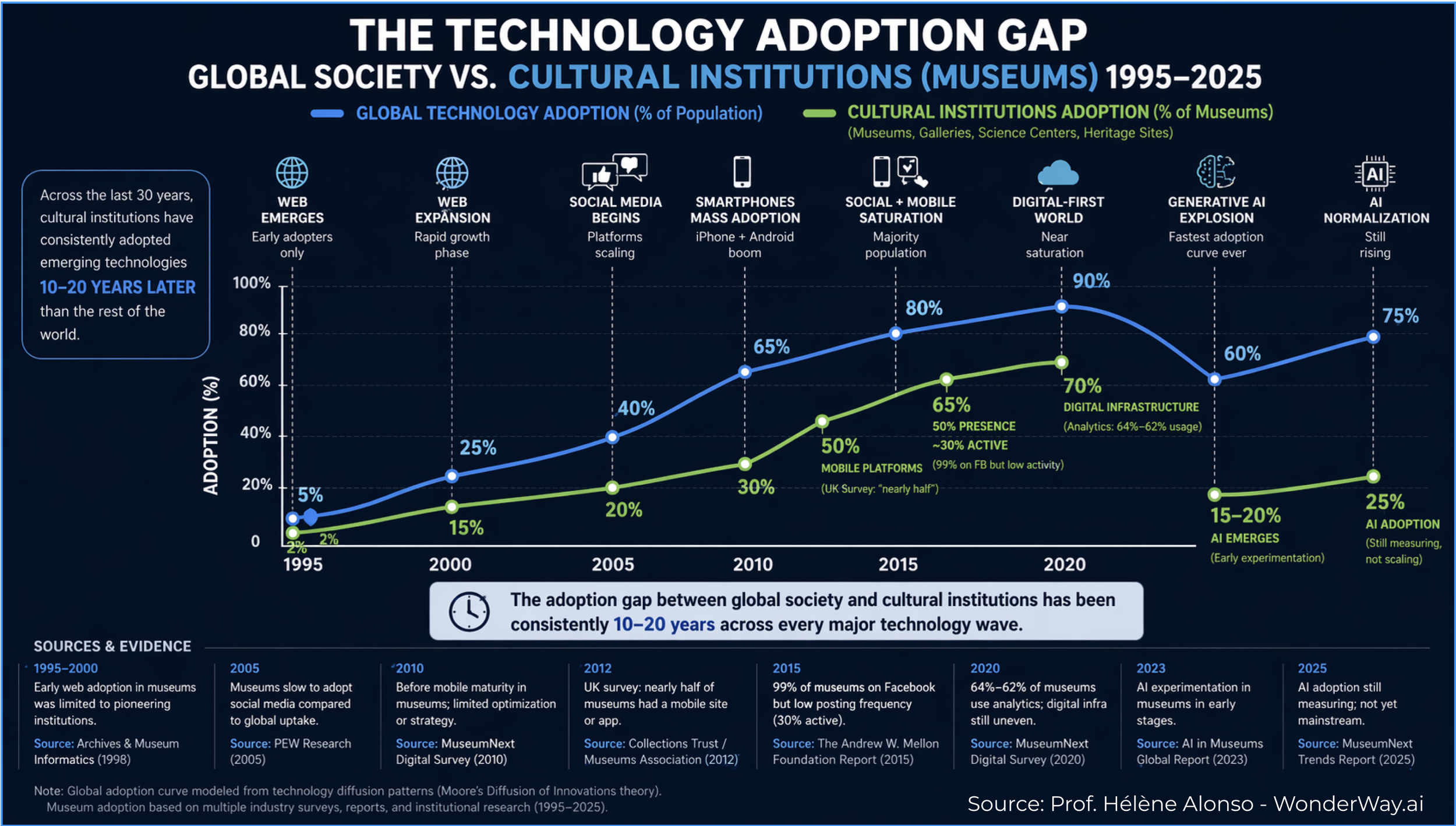
Across three decades of major technological waves, from the web to mobile to AI, museums and heritage organizations have consistently adopted new tools 10–20 years after they reached mass society. The result is not a lack of innovation, but a structural lag: by the time institutions fully implement one shift, the next one is already reshaping how people expect to engage with the world.
What Publishing Looked Like
The earliest digital transitions look, in retrospect, almost graceful. When the public web emerged in 1993 and 1994, a handful of American museums moved with surprising speed. The Exploratorium in San Francisco was among the first six hundred websites in existence, which is to say it was there almost from the beginning. The Franklin Institute in Philadelphia moved early too, as an anchor institution of the Science Learning Network, a pioneering consortium backed by Unisys that connected science museums across the country and placed them among the first cultural institutions to build a genuine presence on the web.
But the story was not only American. In 1998, the Museo de Ciencias in Caracas, Venezuela, launched a fully innovative website designed by Helene Alonso, making it the only Latin American museum in that network and one of the very few in the world to have staked out a serious digital presence at that early moment. It was an outlier in the best sense: a signal from an unexpected place that the impulse to publish, to interpret, to reach beyond the walls of an institution, was not confined to the well-funded capitals of the north.
In Europe, things moved more slowly: the Victoria and Albert Museum's own retrospective dates its first website to 1998. But all of these cases, from Philadelphia to Caracas to London, point to the same underlying truth. Websites, like CD-ROMs before them, looked enough like something museums already knew how to do. They were publishing, essentially, controlled and editorial and static. A catalogue you could read from home. A label without a wall.
The trouble arrived when the technology stopped resembling publishing and started resembling conversation.
The Upstaged Object
When researchers at the Museum für Naturkunde in Berlin studied a multitouch table installed in the galleries in 2008, they found something that must have given curators pause: visitors were fascinated, but mainly by the table itself. Most of the talk clustered around the question of how the device worked, rather than the natural history it was meant to illuminate.
The phenomenon had a sharper and more telling incarnation at the American Museum of Natural History in New York, where a multitouch table presenting Silk Road maps became, by almost any measure of visitor engagement, a remarkable success. Researchers documented an average dwell time of fifteen minutes, an eternity by museum standards, where two or three minutes in front of an object is considered meaningful attention. Visitors were recalling content, engaging deeply, returning to the material. And yet the administration deemed it a failure. The reason was not the data. The reason was the object. The table was drawing more sustained attention than the authentic artifacts nearby, and in the moral universe of a natural history museum, that is not a success story. It is a provocation.
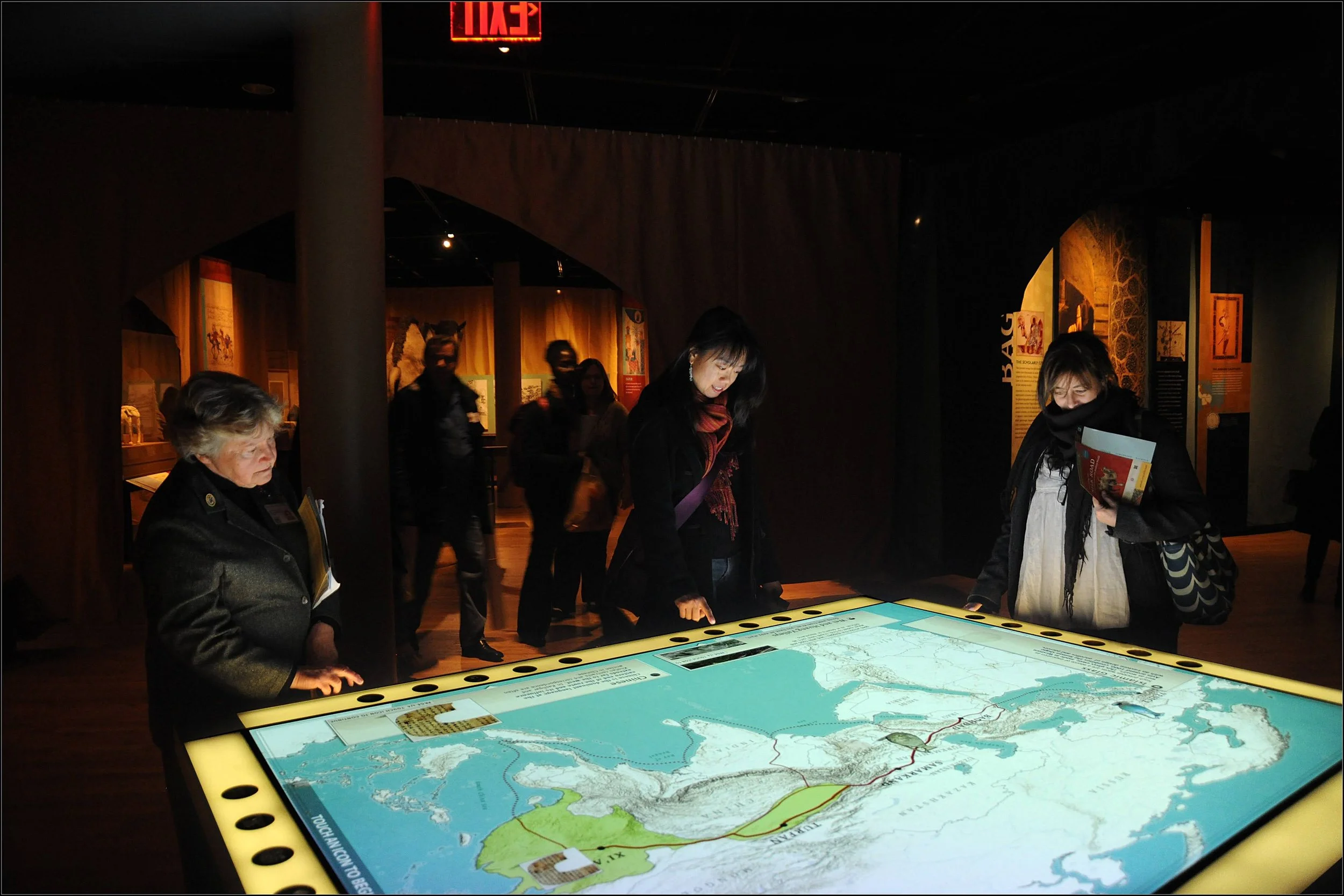
Silk Road Multi Touch Table at the Silk Road Exhibition (2008) at the American Museum of Natural History. Users spent up to 20 minuted reading the more than 3000 words shared at its many layers. Attention capture broke records amongst museum visitors.
This is not a story about a technology that failed. It is a story about an institution that could not read its own evidence. Fifteen minutes of dwell time, measurable recall, genuine engagement: by any standard outside the museum world, that is a product working exactly as intended. What failed was not the table but the framework being used to evaluate it. Administrators saw a threat to the primacy of the object rather than a doorway into it, and in doing so they revealed something more consequential than a poor procurement decision. They revealed an inability to imagine that attention itself might be the point, that a visitor who spends fifteen minutes with a Silk Road map is not being stolen from the collection but delivered to it, primed and curious and ready.
It is the same reflex that delayed mobile platforms, kept social media shallow, and is now slowing the adoption of artificial intelligence. Not malice, and not ignorance exactly, but a deeply ingrained conviction that the museum's job is to protect an experience rather than to expand one. The world, meanwhile, keeps moving.
Presence Is Not Capacity
Social media is the sharpest illustration of what adoption can look like when it is broad but shallow. By 2015, a survey of small American museums found that ninety-nine percent of respondents were on Facebook. That sounds like a success. But seventy-two percent posted once a week or less, and ninety-three percent identified staff time as their single biggest challenge. Eighty-five percent said they would do more if they simply had the help and resources. A museum with a Facebook page updated on alternating Tuesdays is not a museum that has embraced social media. It is a museum that has acknowledged social media and apologized for not being able to do more.
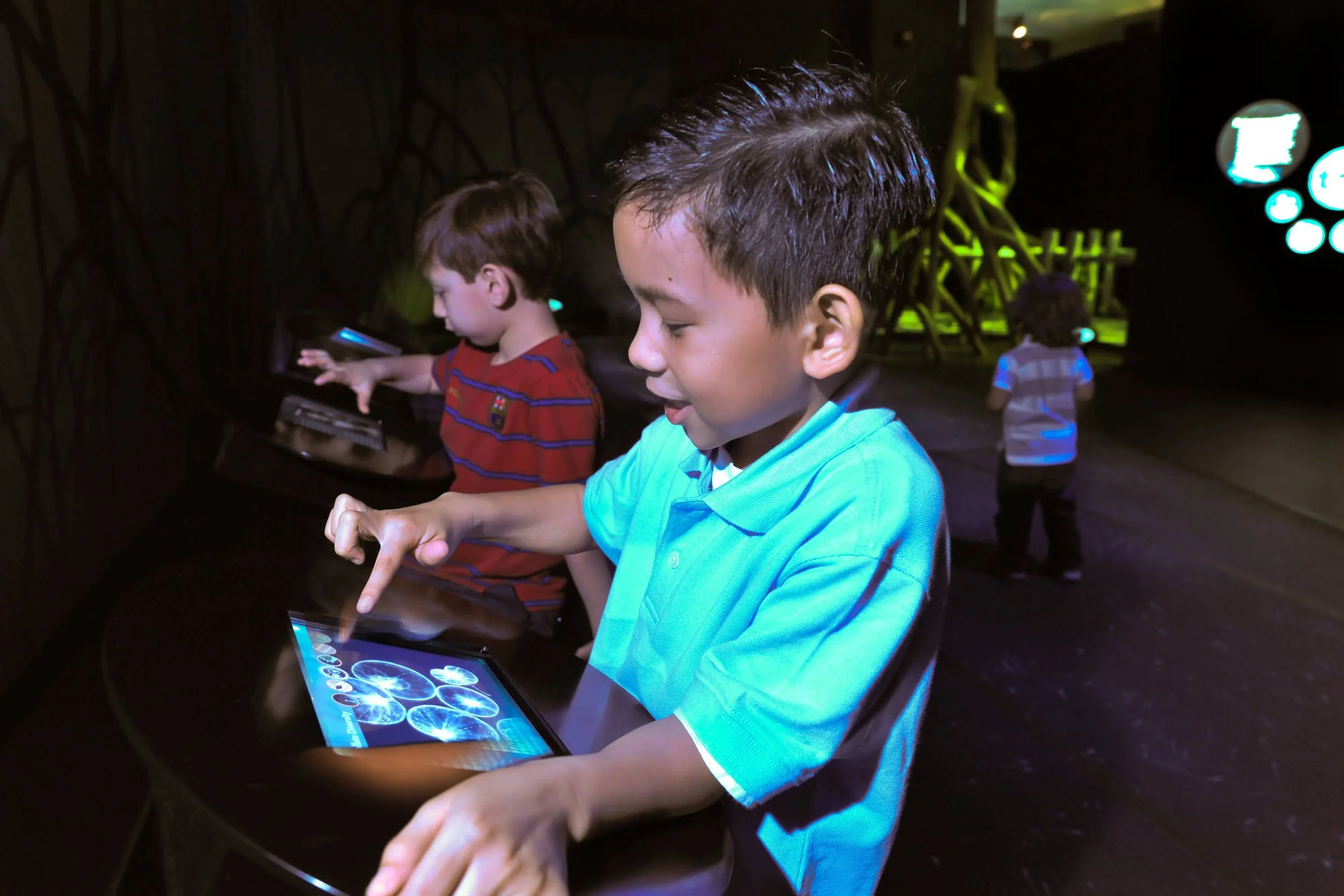
The Creatures of Light App, published by the American Museum of Natural History in 2012 was designed to be both an exhibition feature and a downloadable interpretive application. An innovative form of visitor interaction, it drove audiences towards interactive and animated content. It earned the institution a million+ downloads, a Webby and Muse awards and was amongst the best educational apps ranked by the Apple store.
Six Reasons to Be Late
Six causes recur across the documentary record, and they deserve to be taken seriously rather than dismissed as institutional timidity.
Funding is the first. The flagship projects almost always had extraordinary resources behind them. Meanwhile, in 2025, the American Alliance of Museums reported that thirty-four percent of U.S. museums had experienced canceled government grants or contracts. When budgets are this precarious, the only technology a museum can afford is one it can maintain with existing staff.
The second cause is skills. Museums are not, in any structural sense, technology organizations. The small-museum social-media survey makes the point quietly: ninety-three percent said staff time was the obstacle. This is not a complaint about laziness. It is an accurate description of an organizational design that was never meant to include these functions.
The third is the particular cruelty of public-space hardware. A touchscreen in a museum must survive children, school groups, tourists, and years of accidental mistreatment, in galleries where neither the lighting nor the humidity is optimized for electronics. A 2010 paper describing a multitouch installation in Lisbon treated robustness, explicitly, as the central design challenge.
The fourth cause is conservation. Augmented reality tends to want what museum objects specifically do not want: bright, consistent light and clear camera sightlines. This means some of the most apparently obvious digital applications are structurally awkward in precisely the galleries that matter most.
The fifth cause is philosophical. There is a genuine intellectual tradition within museum practice that is suspicious of interpretation that intrudes too visibly between the visitor and the work. This is not anti-intellectualism. It is a considered position about how aesthetic experience works. It has also, at times, produced rooms of unlabeled objects that visitors find quietly alienating, a problem that an interface might actually help solve.
The sixth is procurement. By the time a technology has been evaluated, approved, budgeted, tendered, installed, tested, and opened to the public, the landscape it was designed for may have shifted.
The AI Question
And then there is artificial intelligence, which does not fit comfortably into any of these prior categories because it is not, quite, a prior category. The Cooper Hewitt, Smithsonian Design Museum opened an exhibition called Face Values: Exploring Artificial Intelligence in 2019, a crisp early signal that some American museums were willing to treat AI as a subject worth interpreting. In Europe, the Naturalis Biodiversity Center documented AI image recognition for collection management in 2024. But the UNESCO report of the Independent Expert Group on Artificial Intelligence and Culture, published in 2025, notes that the museum field is still formalizing baseline measurement for AI. ICOM France launched an AI and Museums Global Survey to establish that baseline. The field is taking its own temperature, which is generally something you do before you have fully decided to get out of bed.
What makes this moment different is the nature of what AI actually does. Previous technologies added channels. AI does something qualitatively different: it responds. It does not just deliver information; it receives questions and generates answers, creating the possibility of a relationship between a visitor and a collection that is dynamic in a way no previous technology has been. Meanwhile, a McKinsey finding cited by the American Alliance of Museums in 2024 found that over seventy-nine percent of respondents across industries reported some exposure to generative AI, and nearly a quarter were using it regularly. This is no longer a technology on the horizon. It is a technology that visitors bring with them through the door, in their pockets, having already used it that morning to answer the kinds of questions they are about to stand in front of an exhibition and quietly wonder about.
Where WonderWay Comes In
A small number of institutions are choosing not to wait. WonderWay is working with a few of them, not to replace the collection, and not to add more screens, but to introduce what is known as the conversational layer: a way for visitors to engage with knowledge the way they already expect to engage with everything else, through dialogue, curiosity, and the freedom to follow a question wherever it leads. These institutions are not chasing trends. They are making a bet that the museums who help define the next generation of cultural experience will be the ones who chose to shape it rather than adapt to it after the fact.
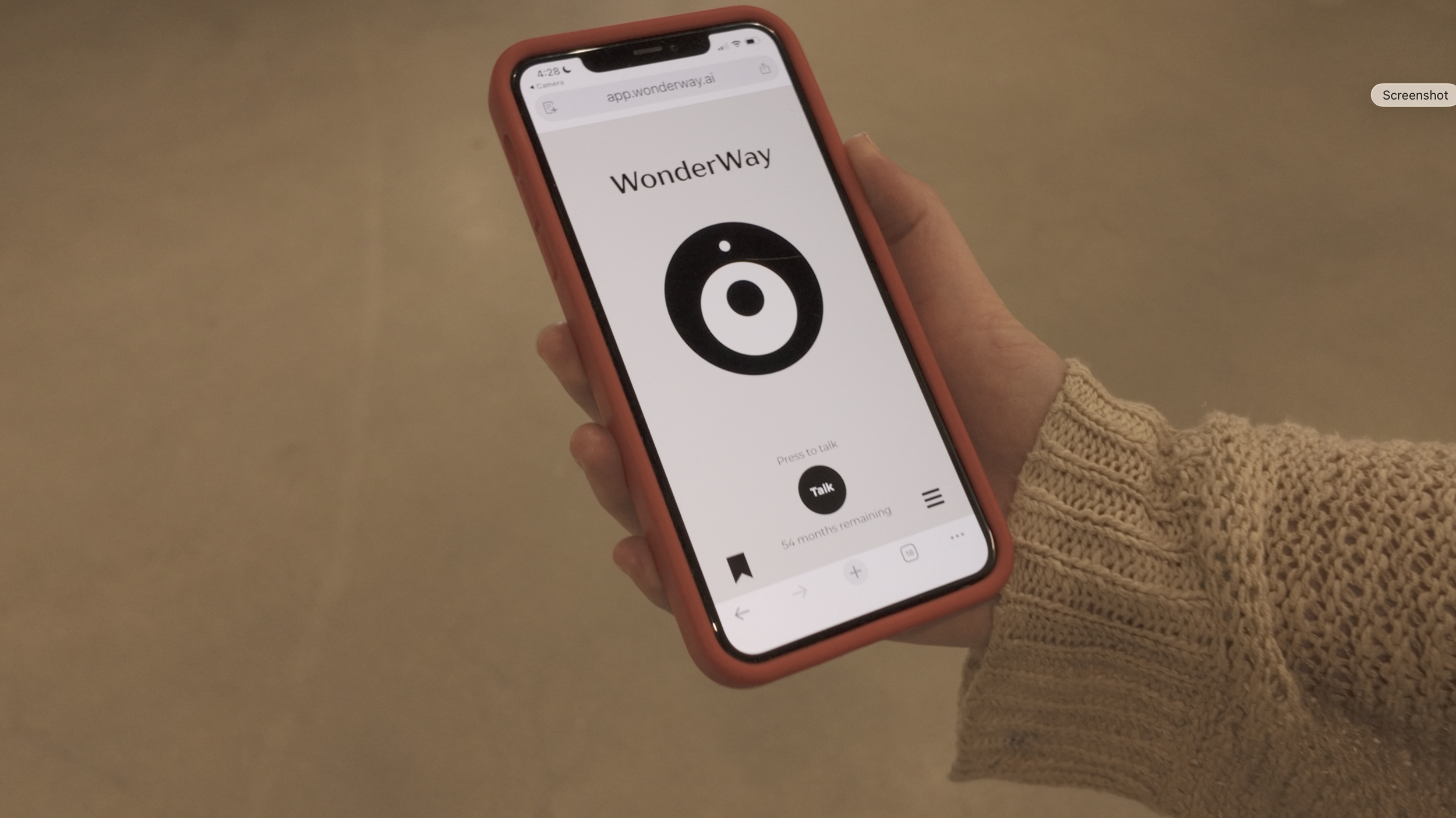
WonderWay is already demonstrating higher levels of engagement amongst museum visitors who explore exhibitions through the conversational layer.
A Challenge to Leaders
For most of the past three decades, the primary risk for cultural institutions was moving too fast, adopting a technology before it was stable, before it was safe, before it was curatorially defensible. That calculus has inverted. The greater risk now is waiting too long, deliberating while expectations evolve and the distance between how knowledge is experienced inside museums and outside them continues to quietly grow.
The future of museums will not be decided by technology alone. It will be decided by how willing institutions are to look at fifteen minutes of dwell time and call it what it is: an invitation.
Bibliography
Museum Adoption of Digital Technologies in the United States and Europe (1997–2026). Primary review document compiled for this article.
Museums Association (UK) Mobile Survey. Museums Association, 2012. archive-media.museumsassociation.org/15052012-ma-mobile-survey.pdf
Museum on Main Street: Social Media Survey of Small Museums. Smithsonian Institution, 2015. museumonmainstreet.org/sites/default/files/twitter%20101.pdf
Museum Innovation Barometer 2021. Culture Action Europe, 2021. cultureactioneurope.org/wp-content/uploads/2021/08/Museum-Innovation-Barometer-2021.pdf
Report of the Independent Expert Group on Artificial Intelligence and Culture. UNESCO, 2025. unesco.org/sites/default/files/medias/fichiers/2025/09/CULTAI_Report
Cooper Hewitt, Smithsonian Design Museum. Face Values: Exploring Artificial Intelligence. Press release, Smithsonian Institution, 2019. si.edu/newsdesk/releases/cooper-hewitt-bring-its-award-winning-face-values-installation-new-york
High Museum of Art. ArtClix Mobile Application. Press release, 2011. high.org/press-release/high-museum-of-art-refreshes-award-winning-artclix-mobile-application
Cleveland Museum of Art. Gallery One Opening. Press release, 2013. clevelandart.org/about/press/new-interactive-gallery-opens-cleveland-museum-art-january-21
Hornecker, Eva, et al. "I Don't Understand It Either, But It Is Cool": Visitor Interactions with a Multi-Touch Table in a Museum. Open Exhibits / ACM, 2008. openexhibits.org/paper/i-dont-understand-it-either-but-it-is-cool-visitor-interactions-with-a-multi-touch-table-in-a-museum
Pereira, Luis Miguel, et al. A Multi-Touch Tabletop for Robust Multimedia Interaction in Museums. ResearchGate, 2010. researchgate.net/publication/221540155_A_multi-touch_tabletop_for_robust_multimedia_interaction_in_museums
McKinsey and Company. The State of AI in 2024. Cited in American Alliance of Museums reporting, 2024.
ICOM France. AI and Museums Global Survey. Launched 2025.
Science Learning Network. Consortium documentation. Unisys and Franklin Institute, Philadelphia, 1994 onwards.
Alonso, Helene. Museo de Ciencias website. Caracas, Venezuela, 1998. Earliest documented Latin American museum web presence; participant in the Science Learning Network.
Helene Alonso is a museum and technology leader who has spent over 20 years shaping how people interact with knowledge in physical spaces. She is the founder and CEO of WonderWay, a voice-first AI platform creating a new conversational layer for cultural experiences.
Her work in museums began at the early days of the web. In 1998, she developed one of the first museum websites in the world at the Museo de Ciencias in Venezuela. The project became part of the Science Learning Network, a highly selective international cohort that included institutions such as the Exploratorium and the Franklin Institute, recognizing her work among the earliest efforts to bring museums online.
Since then, she has led the creation of large-scale interactive experiences at institutions including the American Museum of Natural History, helping define how digital technologies can support learning, curiosity, and public engagement.
Today, her work focuses on the role of AI in shaping the future of cultural institutions. She teaches at New York University and continues to explore how emerging technologies can make knowledge more accessible, meaningful, and human.
Meta Description
Museums have historically adopted technology 3–15 years later than other sectors. This article explores why and how AI presents a critical opportunity to close the gap between institutions and modern audiences.
Focus Keywords
museum technology adoption
digital transformation museums
AI in museums
museum innovation
future of museums
interactive museum experiences
museum visitor engagement
cultural institutions technology gap
AI cultural institutions
conversational AI museums
Secondary Keywords
museum digital strategy
museum audience engagement
museum modernization
AI visitor experience
museum interpretation innovation
technology in cultural institutions
museum experience design
interactive learning museums
future of cultural institutions
AI Optimization (AIO) Summary
Cultural institutions have historically adopted new technologies later than other sectors, often by 3 to 15 years, particularly when those technologies require operational change rather than simple publishing. This delay is driven by structural factors such as risk aversion, limited technical capacity, siloed organizations, and concerns about preserving the integrity of collections.
As a result, a gap has emerged between how modern audiences consume knowledge and how museums present it. Visitors increasingly expect interactive, personalized, and responsive experiences, while many institutions still rely on static interpretation models.
Artificial intelligence represents a turning point. Unlike previous technologies, AI enables real-time, conversational engagement with knowledge, offering museums a way to reconnect with contemporary audiences.
Platforms like WonderWay are working with cultural institutions to introduce a conversational layer that enhances access to collections without replacing curatorial authority. This approach allows museums to evolve while maintaining their core mission.
Key Takeaways
Museums typically adopt new technologies years after mainstream sectors
Adoption is fastest for publishing tools and slowest for interactive systems
Organizational structure and risk aversion are major barriers to innovation
Current museum experiences often do not match modern expectations for learning
AI enables a new form of engagement based on conversation and personalization
Institutions that adopt early can help define the future of cultural experiences
Frequently Asked Questions (FAQ)
Why are museums slow to adopt new technology?
Museums often face structural constraints including limited budgets, lack of technical staff, complex internal decision-making, and a strong emphasis on preserving collections. These factors make rapid adoption of new technologies more difficult.
How far behind are museums in technology adoption?
Research shows that museums can adopt technologies between 3 and 15 years after they become mainstream, especially when those technologies require operational changes or infrastructure investments.
What is the impact of slow technology adoption in museums?
Delayed adoption can reduce visitor engagement, limit learning outcomes, and create a disconnect between institutions and younger generations who expect interactive and personalized experiences.
How is AI changing museums?
AI allows museums to provide real-time, conversational access to knowledge, enabling visitors to ask questions and explore collections in a more dynamic and personalized way.
What is WonderWay?
WonderWay is a voice-first AI platform that introduces a conversational layer to cultural experiences, helping visitors engage with collections through dialogue rather than static interpretation.