Before We Talk About AI, We Need to Talk About Fear
The human challenge behind AI adoption in museums and cultural institutions
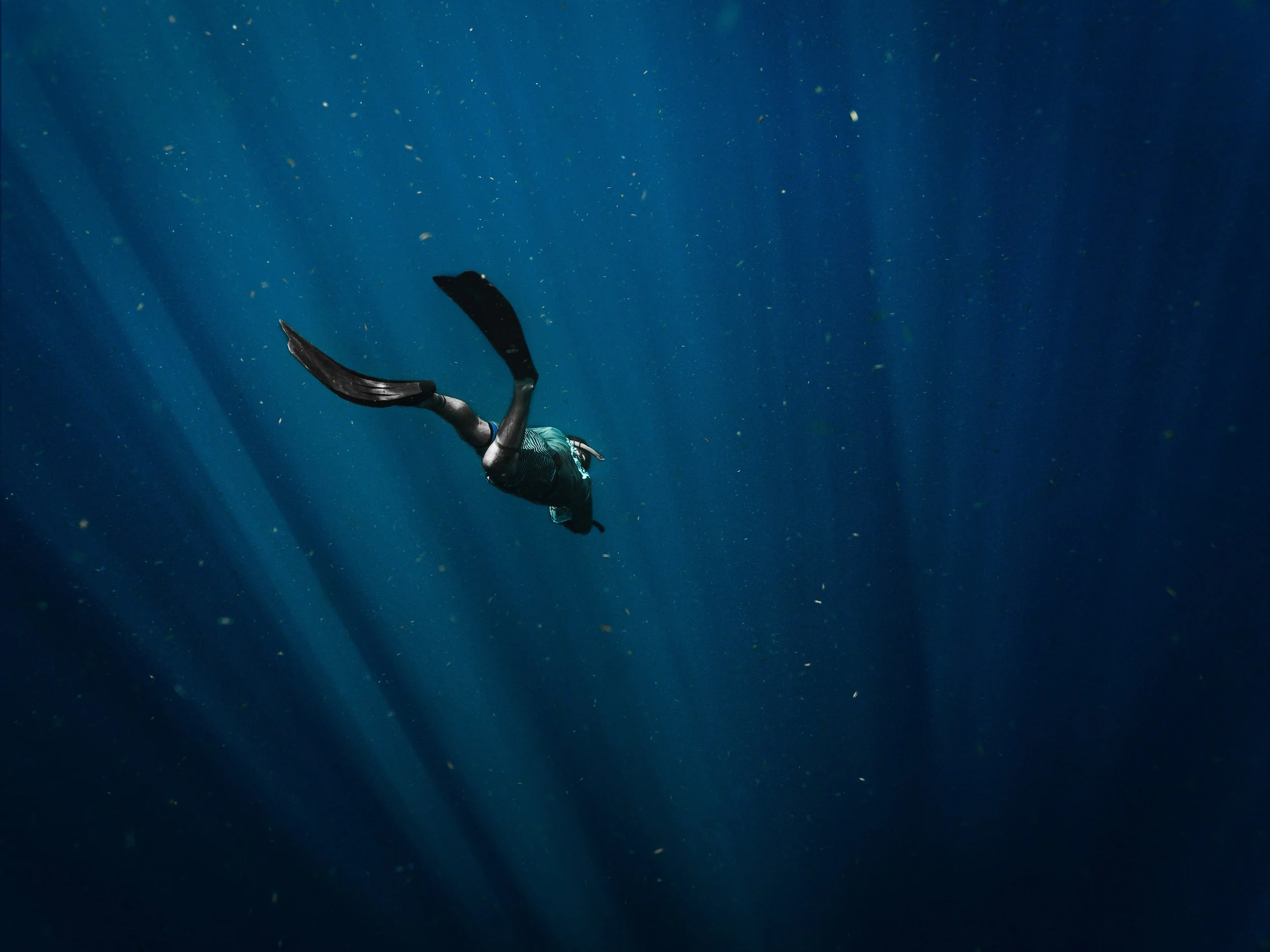
I am afraid of the deep ocean. The darkness, the pressure, the unknown monsters it hides. It has always felt, to me, like a rehearsal for death.
Twenty years ago I took a scuba diving class anyway. Not to conquer the fear; I wanted to understand it, which required getting close enough to see it clearly. So I descended, dive after dive, past the point where I wanted to turn back. The fear did not disappear. But it became specific, and specific fears are manageable. You learn the rules. You come back up.
AI feels the same way. I cannot see the bottom. But I have learned that the only move that has ever worked for me is to go toward the thing, not away from it.
I think about that a lot these days. I have two sons. The ten-year-old wants to be a geneticist so he can make real Pokémons. The twelve-year-old is developing into a lawyer, a talent already visible in the sophistication of his arguments about everything. I watch them and feel the particular anxiety of a parent who cannot say, with any confidence, what they should study, or what skills will still mean something when they are twenty-five.
My mother never learned the internet. To this day she cannot reliably distinguish between her cell phone battery, her cell signal, and her internet connection (three separate mysteries she treats as one general condition of the phone “not working.”) She is not incurious. But she did not get on the train, and now the train has left, and there are whole dimensions of modern life in which she cannot function alone. I love her. I also do not want to become her.
And then there is the work. I am the founder of a company that builds AI voice companions to talk about culture, science, knowledge, which means I spend my days at the intersection of artificial intelligence and cultural institutions — the future and the past — (yes, these are my own damned M dashes) and I can tell you from close observation that the view from that intersection is not simple.
Here is what the data actually shows, and it is stranger and more human than the headlines suggest.
There is still no single official global figure for museums using AI. UNESCO and ICOM launched the first global survey on the subject in May 2026, meaning the field is operating without an authoritative worldwide benchmark. The strongest cross-country number comes from a survey of 266 museum professionals across 27 countries: 18% said they were currently using AI at work, 71% were not. In the UK cultural sector, 67% of organizations had tried at least one AI tool, but only 3% called it embedded in daily work.
Eighteen percent. For a technology we are told is reshaping civilization, that number lands quietly. The researchers’ summary is blunt: adoption is real, but shallow and uneven. The field is not in transformation. It is in a waiting room.
The emotional pattern is consistent across every survey: interest is high, but confidence, governance, skills, and resourcing lag. One research cohort described the feeling as running in simultaneous pairs — “scepticism and optimism; fear and excitement; caution and openness.” Museum staff are not broadly anti-AI. They read, as one research team put it, as “interested but under-protected.” That is not the language of technophobia. It is the language of people standing at thirty feet, wondering whether their equipment is good enough for what comes next.
What are museums actually using AI for? Not the things that make magazine covers.
The most common applications are unglamorous: OCR and handwritten text recognition to make centuries of records searchable; image classification to organize archives no human team could process in a lifetime; metadata enrichment; visitor flow analysis; read-aloud accessibility tools. UNESCO’s 2025 culture report adds one more category I find quietly remarkable: AI-supported HVAC and humidity optimization in museum settings. The algorithm is adjusting the thermostat so the Rembrandts do not crack.
This is the story that does not get told because it is not dramatic enough. There is no robot replacing the curator. There is a system doing work that was always necessary and never adequately staffed: the digitization backlog, the accessibility gap, the cataloguing that kept getting deferred because there were never enough people and never enough time. The scale was always impossible. Only 6% of survey respondents thought their institution was digitally future-proof, and 88% reported no dedicated AI roles. The institution is not resistant. It is under-resourced, which is a different problem with different solutions.
The public, it turns out, has strong opinions about all of this.
In a 2026 study of nearly 99,000 museum-goers and 2,045 American adults, 43% said they expect human beings to create all museum content. Just 9% were comfortable with AI used in exhibitions without restriction. On disclosure, 45% wanted to know every time AI was involved, and another 36% specifically at exhibition level. The dominant concerns: accuracy, staff replacement, erosion of human creation, ethical sourcing, and silence about AI’s role.
When I read this data, my reaction was not surprise. It was recognition. When we built WonderWay, we made a deliberate early decision: the content would come from curators. Not from language models generating plausible exhibition copy, but from the human beings who had spent careers thinking about these objects and stories. The AI carries the voice across twenty languages. It handles the scale, the accessibility, the availability. But the knowledge, the judgment, the meaning, that stays with people.
That decision was not purely strategic. It was a position about what culture is for. We have museums because human beings decided that some things (human things mostly) were worth preserving and passing on. That decision was made by people. It should remain with people. Protecting human ideas and human creation is not a constraint on the tool. It is the reason the tool exists.
A phrase from the MAIA survey has stayed with me. Museum professionals describing AI said: it is “not a magic wand.” Outputs still needed checking, interpretation, human judgment.
That is not a Luddite position. It is a professional one. The equipment does not think for you. The depth does not forgive you for confusing confidence with competence.
The MAIA data also found that 72% of respondents who had used AI called the application successful, and 58% of those applications were still running at survey time.
The path is not around the fear. It is through it. You go toward it, you learn its rules, you make sure the people in the water have proper training and clear governance and the visible guarantee that their expertise is valued rather than replaced.
What I would tell my sons, the geneticist, the litigator, is not which major to choose. It is this: learn to stay curious in environments that make other people want to leave. Understand that expertise is not a destination. Adapt, confront, look at the depth in the eye.
What I would tell cultural institutions is what diving taught me: the solution is not to stay on the boat. Look at what is coming, feel the fear, and then decide what you care about enough to fight for. Pick up the tool and shape it to your values, not the other way around. Insist that human judgment, human creation, human meaning remain structural requirements, not concessions to sentiment, but the actual point.
The museums that will matter in twenty years are not the ones that adopt AI fastest. They are the ones that adopt it most deliberately, and keep asking: is the curator’s, the exhibitions team’s, the educators’ (the audience’s) voice still in the room?
The depth does not care whether you are ready. But you get to decide how you descend.
Helene Alonso is a museum and technology leader who has spent over 20 years shaping how people interact with knowledge in physical spaces. She is the founder and CEO of WonderWay, a voice-first AI platform creating a new conversational layer for cultural experiences.
Her work in museums began at the early days of the web. In 1998, she developed one of the first museum websites in the world at the Museo de Ciencias in Venezuela. The project became part of the Science Learning Network, a highly selective international cohort that included institutions such as the Exploratorium and the Franklin Institute, recognizing her work among the earliest efforts to bring museums online.
Since then, she has led the creation of large-scale interactive experiences at institutions including the American Museum of Natural History, helping define how digital technologies can support learning, curiosity, and public engagement.
Today, her work focuses on the role of AI in shaping the future of cultural institutions. She teaches at New York University and continues to explore how emerging technologies can make knowledge more accessible, meaningful, and human.
Sources: MAIA Survey, University of Manchester (266 museum professionals, 27 countries); Europeana AI in Relation to GLAMs Task Force Report; Interactive Heritage: The Role of Artificial Intelligence in Digital Museums; HDK AI in Arts Marketing: Takeaways from 92 Arts Organisations; Arts Marketing Association / CultureHive Together We Act Deep Dive: AI and Digital Confidence; The Audience Agency Let’s Get Real AI Report; AAM / Wilkening Consulting, AI in Museums and Community Trust: A 2025 Annual Survey of Museum-Goers Data Story (202 museums; 98,904 museum-goers; 2,045 US adults); Ithaka S+R Art Museum Director Survey 2025; NEMO Museums and AI Conference Summary; UNESCO Independent Expert Group on Artificial Intelligence and Culture Report, 2025; UNESCO / ICOM Global Survey on the Use of Artificial Intelligence in Museums, launched May 2026.